 Sadhya
 Imagine standing in front of a thousand-year-old pyramid that literally turns into a giant snake… twice a year. Welcome to Chichén Itzá, one of the New Seven Wonders of the World. And today, I’ll show you exactly how to explore this place without a guide — every temple, every hidden detail, in one self-guided tour.
Chichén Itzá is smack in the middle of Mexico’s Yucatán Peninsula. It’s huge, insanely popular, and yeah — very touristy. But if you know where to go, in what order, you’ll dodge the crowds and get the best experience. Let’s dive in.
This ancient city was founded around 400 CE and peaked by the 10th century with up to 50,000 residents. The name literally means “at the mouth of the well of the Itzá” — because cenotes, or natural wells, were their lifeline. By the 1100s droughts hit, people left, and the city slowly declined. Fast-forward to today: UNESCO World Heritage site since 1988, and one of the New Seven Wonders since 2007.
🎥 Watch: Explore the Ancient Wonder of Chichen Itza

Step back in time and explore the magnificent ruins of Chichen Itza — one of the New Seven Wonders of the World. Don’t forget to subscribe for more breathtaking travel videos!
Temple of Kukulcán (El Castillo)
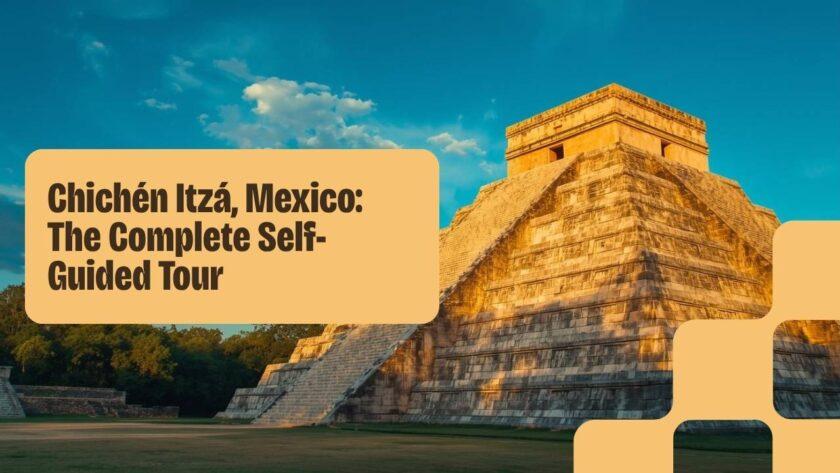
Walk down the entrance path, and suddenly — there it is. The Temple of Kukulcán, rising 30 meters into the sky.
The star of Chichen Itza is El Castillo, also known as the Temple of Kukulcán.
At first glance, it’s just a pyramid. But it’s actually a giant calendar carved in stone. Each of its four sides has 91 steps. Add the top platform, and you get 365 — the number of days in a year.
And twice a year, during the spring and fall equinox, sunlight creates the illusion of a serpent slithering down the pyramid’s steps — a tribute to the feathered serpent god, Kukulcán. It’s a breathtaking show of Mayan engineering and astronomy.
And here’s the trick: clap at the base of the stairs. The echo bounces back, sounding like the cry of a quetzal bird. A perfect example of Mayan science and design.
Tip: walk a full circle around the pyramid. The far side is quieter, and in the morning, the light is better for photos.
At its peak, Chichen Itza was a major political and economic center. Merchants, warriors, and priests gathered here, and the city thrived as one of the largest in the Maya world. Its architecture blends influences from across Mesoamerica — proof of its far-reaching connections
The Great Ball Court
Next stop: head northwest. This is the largest ball court in all of Mesoamerica. 70 meters wide, 168 meters long, walls 12 meters tall.
The game? Pok Ta Pok. Here, players competed in a sacred ball game, using only their hips to hit a heavy rubber ball through stone rings high on the walls. For the Maya, this wasn’t just sport — it was ritual, often tied to sacrifice and the gods.
Look closely at the carvings: players, serpents, and even headless corpses. Historians still debate — did the winners get sacrificed, or the losers?
The Temple of the Jaguars
Chichen Itza is filled with smaller wonders too, like the Temple of the Jaguars. Located near the ball court, decorated with jaguar and warrior carvings, symbolizing strength and the underworld. Jaguars were sacred in Mayan culture, connected to both royalty and the spiritual world.
The Wall of Skulls
Exit north, turn right, and boom — a platform covered in carved skulls. This is the Tzompantli, or Wall of Skulls. Some say it showed the heads of sacrificed warriors, others think it was linked to the ball game. Either way — creepy.
The Sacred Cenote
Follow the path north through the vendors and jungle trail, and you’ll reach a massive open cenote, a natural sinkhole that connected the Maya to the underworld. Early explorers dredged this in the 1900s and pulled out gold, jade, pottery, and more than 200 human skeletons. It wasn’t for drinking or swimming — it was for offerings. Today you can’t swim here.
Temple of the Warriors
Head back to the main plaza and walk left. Here’s the Temple of the Warriors — a pyramid lined with columns carved with warriors and jaguars. At its summit once rested a Chac Mool statue, a reclining stone figure with its head turned sideways, holding a bowl across its stomach. Offerings — from incense to even human hearts — may have been placed there.
Today, climbing the temple is no longer allowed, and the original Chac Mool has been removed for preservation. Still, the scale of this temple, and the forest of columns surrounding it, is nothing short of impressive.
The Observatory (El Caracol)
Then there’s El Caracol, nicknamed the snail for its spiraling staircase. This tower-like structure is believed to be an ancient observatory. Its windows align with celestial events — the sun at equinox, the rising of Venus, and other key astronomical points.
The Maya didn’t just map the stars for curiosity. They wove them into every part of life — from planting crops to planning wars.
The Nunnery & The Church
Last stop, head south to a complex the Spanish nicknamed “The Nunnery.” It looks like a convent, but it wasn’t — likely a government or palace building. Right next to it is “The Church,” a small temple dedicated to Chaac, the rain god. Look up and you’ll spot multiple Chaac masks stacked along the façade.
Quick Tips Before You Go
Guided tours cost 650–1000 pesos. If that’s too much, grab an audio guide on Get Your Guide.
Best time to arrive? As early as possible. By mid-day it’s scorching hot and crawling with tour buses.
Bring cash, sunscreen, and water.
Don’t expect solitude — this is one of the busiest sites in Mexico.
So, is Chichén Itzá worth it? Absolutely. It’s a World Wonder for a reason. Even if it’s busy, the scale, the math, the astronomy — it’s a mind-blowing reminder of what the Maya accomplished.
Plan Your Visit — Book the Perfect Chichén Itzá Tour
If you’d rather skip the hassle of planning and let the experts handle everything, you can easily book a guided Chichén Itzá tour through Viator. These tours include hotel pickup, skip-the-line entry, and knowledgeable local guides who bring the ancient Mayan world to life.
This post may contain affiliate links. That means if you click and make a purchase, I may earn a small commission — at no extra cost to you. I only recommend tours and experiences I genuinely believe will add value to your travel adventures.